Executive Summary↑
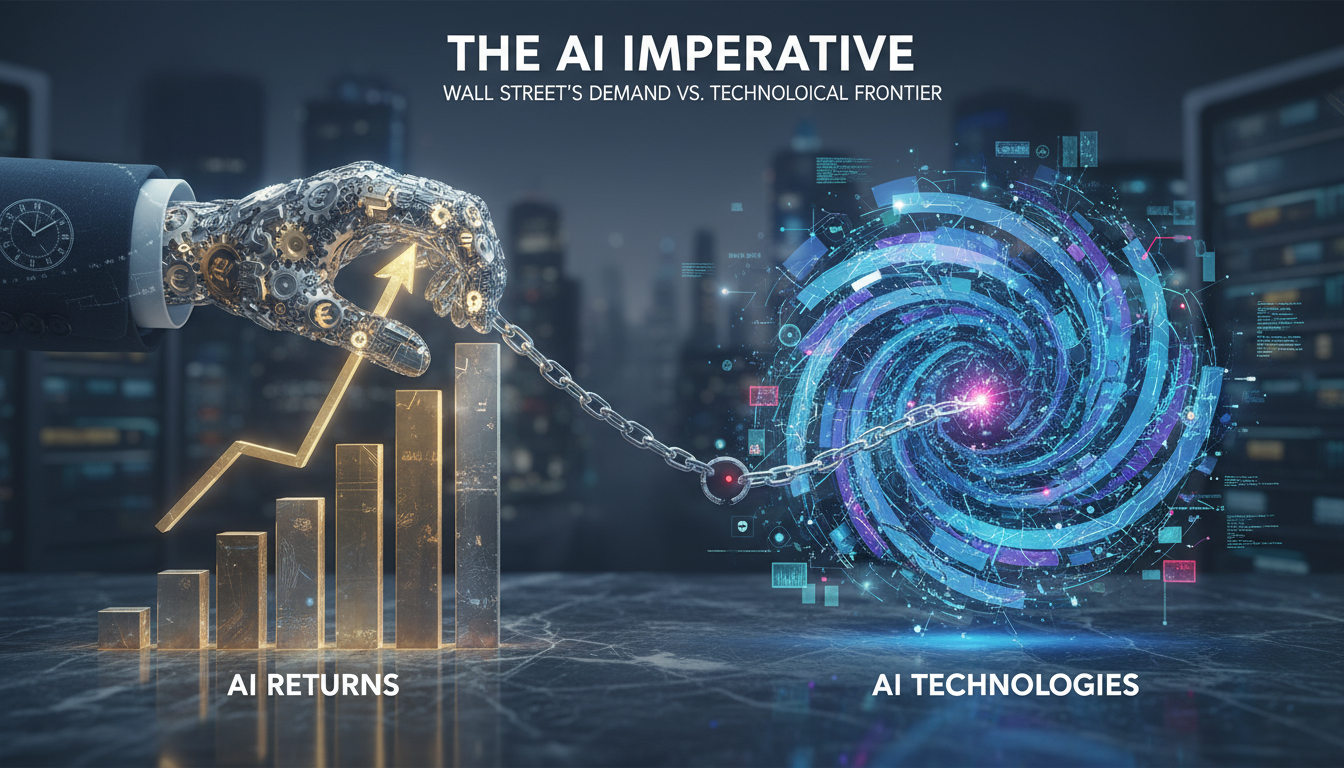
Wall Street's honeymoon with AI promises is cooling into a demand for receipts. Satya Nadella is aggressively defending Microsoft Copilot adoption numbers, while Apple faces mounting skepticism over its path to direct AI monetization. Investors are no longer satisfied with "active users" as a metric. They want to see how these tools translate into durable, high-margin revenue.
Technical development is shifting from raw scale to architectural precision. Researchers are finding that models using "internal debate" show significant gains in accuracy on complex tasks. Meanwhile, tools like Claude Code are proving that specialized agents can handle professional workflows better than general chatbots. We're seeing a move away from simple prompts toward programmatic systems like Daggr that chain applications together for specific business outcomes.
The market is splitting between entertainment and enterprise utility. While some models chase headlines with controversial content, the real opportunity lies in systems that can verify their own logic. Watch for a flight to quality as leaders prioritize agents that don't just talk, but actually think and audit themselves. Future valuations will depend on this move from "generative" to "verifiable" intelligence.
Continue Reading:
- AI models that simulate internal debate dramatically improve accuracy ... — feeds.feedburner.com
- Satya Nadella insists people are using Microsoft’s Copilot AI a lot — techcrunch.com
- Introducing Daggr: Chain apps programmatically, inspect visually — Hugging Face
- AI agents can talk to each other — they just can't think together yet — feeds.feedburner.com
- The AI Hype Index: Grok makes porn, and Claude Code nails your job — technologyreview.com
Product Launches↑
Hugging Face released Daggr, a tool that attempts to fix the messiness of programmatic AI workflows by adding a visual inspection layer. Most developers building agentic chains face a "black box" problem where they can't easily see why a model failed midway through a complex process. This library allows teams to code their apps in Python while the UI renders the logic as a readable, interactive graph. It targets a specific friction point in the $200B enterprise AI sector: the lack of transparency in automated reasoning.
The move positions Hugging Face against established orchestration players like LangChain, but with the benefit of their existing repository of 1M+ models. By focusing on visual inspection, they're betting that developers care more about debugging than flashy autonomous features. If this gains traction, it shifts the narrative from model size to workflow reliability. Watch for whether this becomes the standard for auditing agentic behavior in production environments where mistakes are expensive.
Continue Reading:
Research & Development↑
Scale isn't the only way to squeeze performance out of a neural network. New research into internal debate mechanisms shows that models can significantly improve their accuracy by simulating a "room of experts" during the inference process. Instead of providing the first statistical guess it finds, the system allows internal sub-agents to argue different perspectives until they reach a consensus. It's a move toward algorithmic sophistication that could eventually break our collective addiction to massive training runs.
Investors should watch the cost-per-query as these deliberation techniques go mainstream. If a model can "think" its way to a better answer using more compute at the moment of the request, we might see the value of massive pre-training datasets decline. This shift favors firms with deep expertise in model architecture over those simply sitting on piles of old data. It's much easier to scale a smart process than a heavy one.
Silicon Valley remains divided on whether this can bridge the gap to true reasoning. We're currently seeing a split between companies doubling down on $1B clusters and those focusing on these lean, iterative loops. If the debate method holds up in production, the competitive advantage for companies like OpenAI or Anthropic might rely more on their reasoning logic than their hardware access. Efficiency is finally starting to look like a better bet than brute force.
Continue Reading:
- AI models that simulate internal debate dramatically improve accuracy ... — feeds.feedburner.com
Regulation & Policy↑
A new technical reality is hitting the market: AI agents can exchange information but fail to coordinate their reasoning for complex tasks. This disconnect isn't just a coding hurdle for developers building at Salesforce or Microsoft. It's a looming legal risk for companies that assume these autonomous systems can handle end-to-end business processes without human oversight.
Regulatory bodies like the FTC are likely to view this "reasoning gap" as a consumer protection risk. If two agents misinterpret each other's intent and cause a financial loss, current liability frameworks don't clearly define where one company's fault ends and another's begins. It's a mess that reminds me of the early days of electronic data interchange before global standards stepped in to force a common language.
Smart money is looking for startups solving the "interoperability of intent" problem. Until we have a standard protocol for agentic reasoning, the EU AI Act's requirements for human-in-the-loop oversight will remain a non-negotiable cost for any enterprise deployment. We aren't looking at a quick fix, and the first major lawsuit involving agent-to-agent failure will likely set the tone for the next five years of tech litigation.
Continue Reading:
- AI agents can talk to each other — they just can't think together yet — feeds.feedburner.com
Sources gathered by our internal agentic system. Article processed and written by Gemini 3.0 Pro (gemini-3-flash-preview).
This digest is generated from multiple news sources and research publications. Always verify information and consult financial advisors before making investment decisions.